Best Hinge Prompt Answers That Start Conversations (2026)
Published on 2/7/2025 • Last updated 8/15/2026 • 6 min read
Quick answer: A strong Hinge prompt answer is specific, reveals something real about you, and gives a match an obvious detail to respond to. Adapt the examples below to your own voice, or use Smart Opener to turn a real profile detail into a first message.
Your Hinge prompts are a tiny stage that introduces you before a single message. The strongest answers treat each prompt like a two-line scene from real life: one specific detail, one clear voice, and an easy opening for the other person.
Below you’ll find practical rules that keep answers specific, honest, and easy to answer, adaptable examples in different tones, and a quick edit for blank prompts.
The 5 Golden Rules of Answering Hinge Prompts
These are short rules to use when you write or edit answers. Follow them and your profile will stop sounding like a resume and start sounding like a person.
1. Be specific, not generic
Saying “I love to travel” is fine, but it gives no foothold for conversation. Saying “My goal is to find the best bowl of ramen in every city I visit; Tokyo’s the next stop” tells someone what you care about, gives a natural starter, and reveals personality. Specifics are invites.
Swapping vague adjectives for tiny details makes an answer easier to respond to. Instead of “I like hiking,” write about getting lost on a foggy ridge and finding a field of wild blueberries. The detail gives someone a real conversation starter instead of a generic compliment.
2. Show, don’t tell
If you want to come across as funny, make the answer funny. If you want to be thoughtful, give a short, thoughtful anecdote. Don’t label yourself; demonstrate it.
Example: “I’ll fight you for the last slice of pizza, but I’ll bring you a replacement from the food truck around the corner.” It is playful, generous, and specific.
3. Inject your personality
Dry and sarcastic? Cute and wholesome? Nerdy and enthusiastic? Let that voice come through. Your aim isn’t to appeal to everyone — it’s to attract the people who vibe with you. Pick a primary tone, then let one answer show a soft exception (family dinners, sentimental songs). Contrast makes you three-dimensional.
4. Keep it positive
Avoid defensive lists like “no drama” or long “don’ts.” Frame what you want: “Looking for someone who laughs at bad puns and also loves quiet Sundays.” Positive frames are more attractive and easier to respond to.
5. End with a hook
A great answer invites a response. Add a small question, a playful dare, or a concrete choice. “Which ramen spot should I try first?” is better than “I love food.” Hooks make it easy for someone to message you.
The goal isn’t to be perfect — it’s to be engaging. If your answers make someone want to write to you, you’re doing it right.

Why these prompt patterns help
Specific details give a match something to notice, question, or share. A positive frame keeps the answer welcoming, and a small hook makes the first message easier to write. These patterns improve clarity, but no prompt can guarantee replies or dates for everyone.
Popular Hinge Prompts & Engaging Answers
Below are common prompts with examples across tones so you can pick what fits, plus why each example works and how to tweak it to feel authentic.
"I’m looking for..."
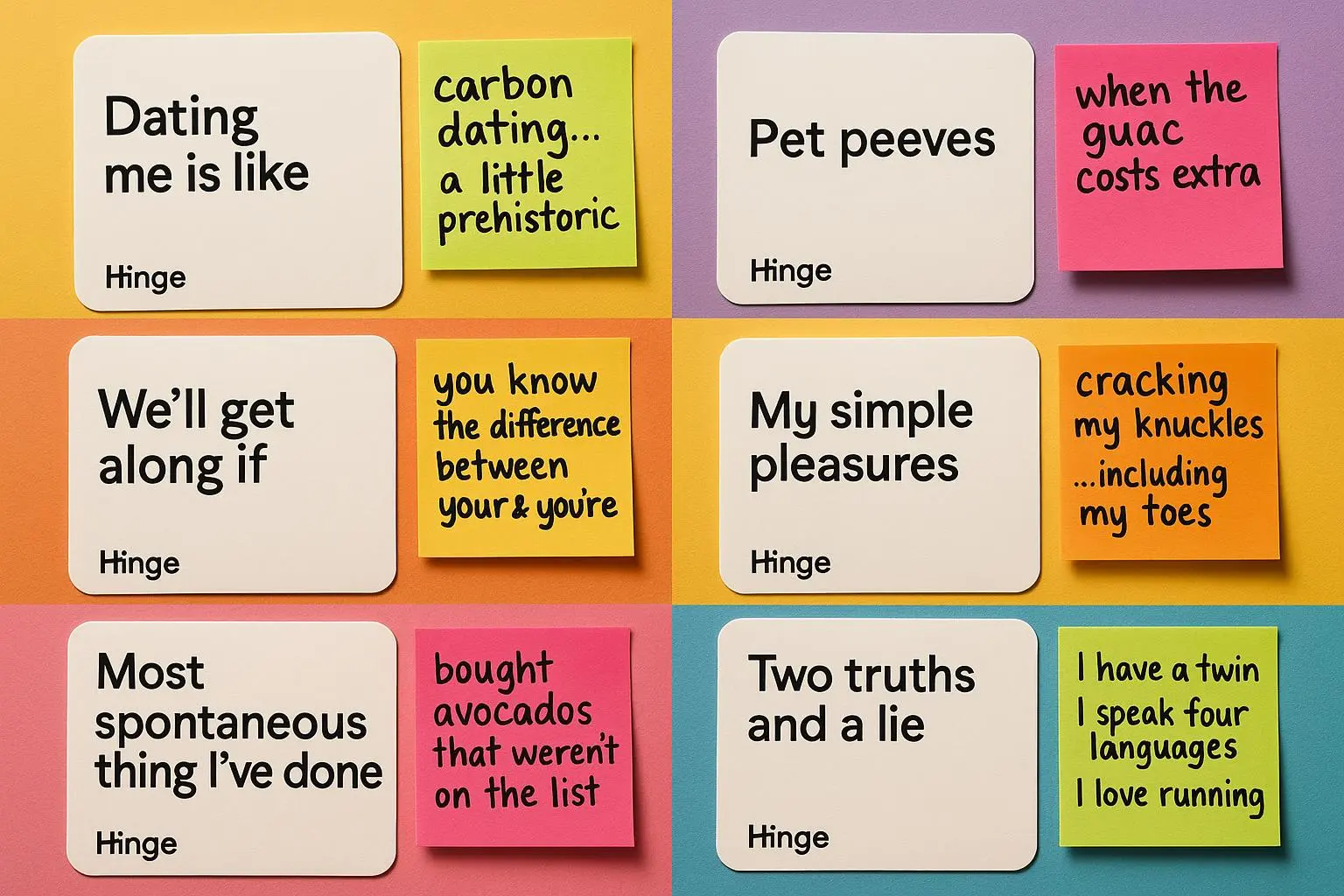
Playful & active: "...someone who will indulge in a competitive game of Mario Kart, but won't be a sore loser. Also, a willingness to share your fries is non-negotiable."
- Why: Specific activity, playful boundary, and a relatable food preference — easy convo.
Thoughtful & sincere: "...a partner in crime for exploring new restaurants, debating A24 plots, and who’s as kind to the waiter as they are to me."
- Why: Shows shared activities and values.
Ambitious & fun: "...someone passionate about work who can unplug for a spontaneous road trip. Bonus points for excellent podcast recs for the drive."
- Why: Balances ambition with downtime and invites a shareable interest.
Tweak tip: Replace the activities with your actual habits — farmers’ markets, board games, whatever you actually enjoy.
"My most controversial opinion is..."
Keep it low-stakes and memorable.
- Foodie: "...that pineapple on pizza is a culinary masterpiece. Don't @ me."
- Pop culture: "...Die Hard is a Christmas movie and I’ll defend it with a 10-slide PowerPoint."
- Silly: "...cereal is a soup. Logic is sound; judge me later."
Tweak tip: Pick an opinion you can defend in a sentence or two — quick, shareable, and debatable.
"Together, we could..."
Paint a date or the relationship vibe.
- Cozy: "...build a pillow fort and binge Studio Ghibli. I’ll bring snacks."
- Adventurous: "...try that weird hiking trail and reward ourselves with tacos afterward."
- City explorer: "...spend a Saturday hunting the city’s best coffee shops and rating them like pros."
Tweak tip: Use real activities you enjoy. Authenticity is easier to sustain in conversation.
"The way to win me over is..."
Vulnerable specificity works.
- Simple: "...remembering what I said last week. Or bringing me coffee without being asked."
- Funny: "...having impeccable meme taste and sending them at random moments."
- Musical: "...making me a playlist. I’ll judge, then be flattered."
Tweak tip: Keep sentimental answers short so they don’t read like a manifesto.
A 90-second prompt edit
Quick routine that turns bland lines into cranky little anecdotes:
- Find the boring word: "funny," "nice," or "outdoorsy." Replace it with an example.
- Add one sensory detail or small moment: a smell, a food, a tiny mishap.
- End with a tiny hook: a question, a dare, or a choice.
Live edit example:
- Start: “I love coffee and travel.”
- Swap: “I’m addicted to single-origin espresso and finding tiny cafés on misread maps.”
- Add sensory: “The espresso smells like caramel and regret (in a good way).”
- Hook: “Recommend a café?”
Final: "I’m addicted to single-origin espresso and finding tiny cafés on misread maps — the espresso smells like caramel and regret (in a good way). Recommend a café?"
It sounds human because it includes a small mistake and a sensory cue — texture people respond to.
What to avoid (and quick fixes)
- Too many filters: Condense demands into a values line: "Curiosity, kindness, and someone who laughs easily."
- Says nothing: Add one small story or concrete image.
- Passive-aggressive phrasing: Replace "don’t" with positive alternatives.
- Overused lines: Personalize with a detail.
Have a real profile detail but no natural first line? Use Smart Opener to turn it into a few editable drafts, then keep only the option that sounds like you.
If one answer gets no traction, swap the tone — joke if you’re usually serious, or be sentimental if you’re usually jokey.
When to use humor vs. sincerity
Both work. Match the tone to the prompt and to the person you want to meet. Humor opens doors quickly; sincerity builds trust. Mix them: one witty line, one sincere story.
If unsure, err on warmth — it reads as approachable more often than pure cleverness.
Examples to adapt
These are illustrative examples, not measured user outcomes. Replace every detail with something true about you.
"I volunteer weekends at a community garden. I come home with dirt under my nails and stories about the old woman who insists tomatoes taste better if you talk to them." — shows values, tactile detail, and a quirky anecdote.
"My signature dish is a surprisingly good shakshuka. I’ll make it if you bring a bottle of something we both pretend to know how to pair." — invites shared activity and playful intimacy.
"If we match, I’ll tell you the story of how I accidentally joined a wedding party in Portugal because I followed a marching band." — a story-promise that prompts: “Tell me now.”
Those story-promises create curiosity without oversharing.
Pro tip on inspiration tools (disclosure included)
Rizzman publishes this article, and Smart Opener is one of our tools. Open Smart Opener when you want inspiration rather than finished copy: choose one useful direction, then rewrite it until it sounds like you.
Neutral alternative: ask a friend for two truths + a tiny anecdote, or use a free writing timer (5 minutes) to produce one short story about a small moment. Then edit that down into a prompt answer.
Conversation starters that actually work
Use cues from someone’s answers as inroads. Examples:
- If they mention a food: "You said you love [dish]. I have a rec that’ll change your life."
- If they shared a story: "Tell me more about the wedding in Portugal — need details."
- If they ended with a question: Answer it, then add a twist: "Yes — try ramen at X. Are you a chopsticks purist or utensil rebel?"
Key: be specific, reference what they wrote, and add a small personal detail.
Final edits before you hit save
Read your answers out loud. Do they sound like you? Ask a friend who knows your humor to read them. Keep your profile focused: a couple witty lines, one or two small stories, and one answer that reveals values. That’s a profile that invites messages and filters out the wrong ones.
Your profile, your personality
There’s no single perfect Hinge profile, only the one that genuinely reflects you. Use the rules and examples here as scaffolding, not formulas. Be specific, show your voice, and leave room for curiosity. Generate a few profile-aware opener drafts with Smart Opener when you want a starting point for the next message.
If you want a shortcut for idea generation, use a prompt generator or ask a friend for a quick tone check. Use suggestions as inspiration as you edit until the answers sound like you.
Now go update your profile: write one small story, add a question to one answer, and wait for the messages that feel worth replying to.
A final honesty check
Before saving, read each answer out loud. Keep the details true, remove claims you cannot support, and make sure the voice sounds like you rather than a template.
References
This is practical writing advice, not a formula for matches or a measured promise of more replies. It is informed by research on online self-presentation and deceptive profile behavior, including Ellison, Heino, and Gibbs and Toma, Hancock, and Ellison. Those studies provide context for writing an authentic profile, not a guarantee that any single prompt style will work for everyone.
Try the tools
Put this advice into action
Use the matching Rizzman tools to turn the advice into a stronger profile, opener, or reply.
Dating Profile Optimization: Complete Guide to Getting More Matches (2026)
Step-by-step dating profile optimization with photo strategy, AI photo rating, bio formulas, and Tinder, Hinge, and Bumble tactics for better matches.